How we approach Shopify SEO on a store we run ourselves: collection pages, product templates, duplicate URLs, schema, apps and internal links, with the Search Console numbers.
Most Shopify SEO advice is a checklist of settings. The settings matter less than people think. What decides whether a store ranks is usually the theme, the way the catalogue is structured and what Google finds when it crawls. This is the order we work in on a Shopify store, and the numbers from a Shopify brand we run.
Want it done for you?
We do the SEO and the theme work on Shopify stores ourselves, so the fixes get made, not just listed.
Shopify SEO is ecommerce SEO on one platform. Shopify handles payments, hosting, checkout and a sitemap for you, so none of that needs rebuilding.
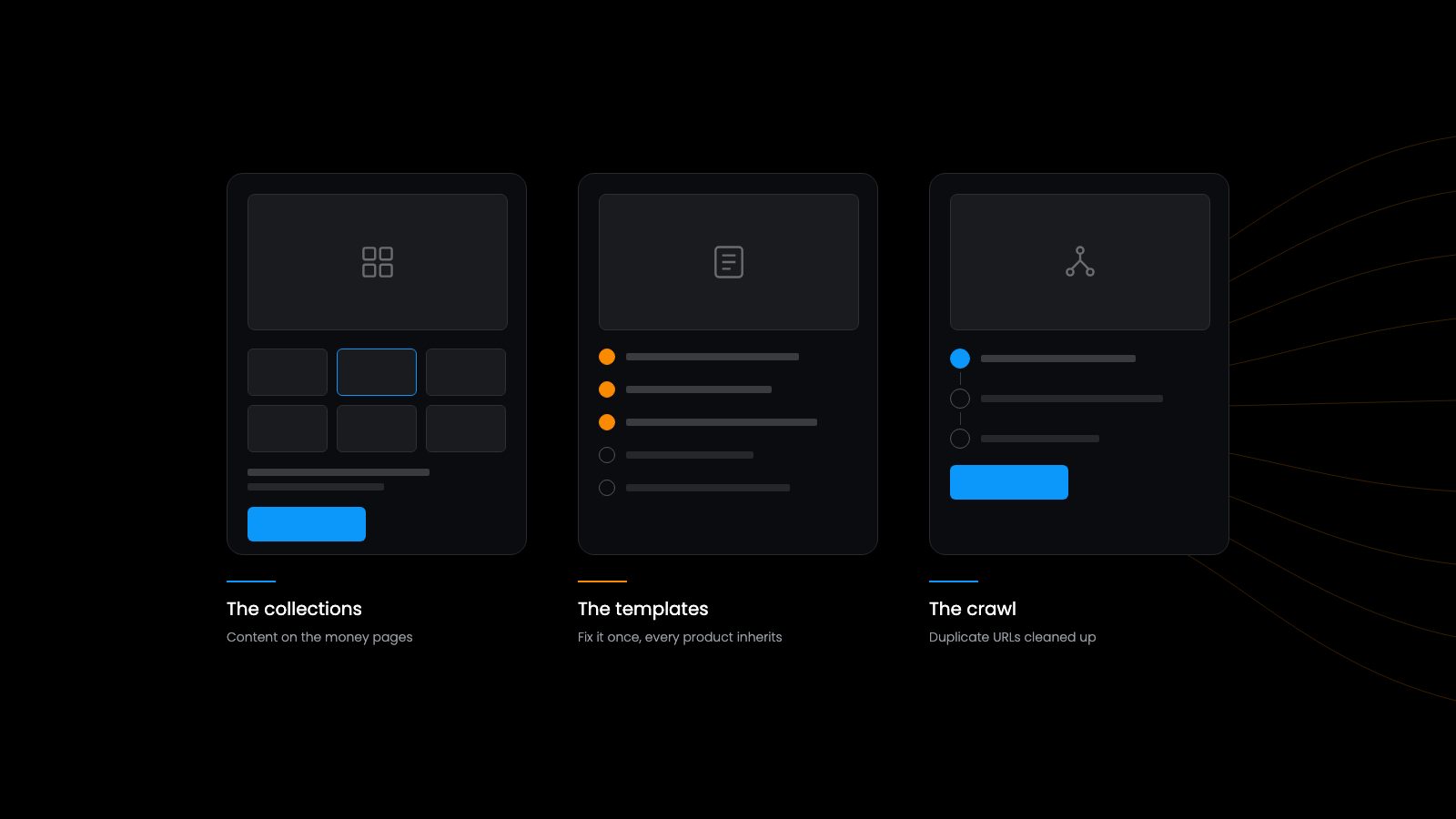
What it leaves you with is the theme, the collections and the crawl. Ecommerce SEO problems usually live in all three at once, which is why we do the SEO and the theme work together.
Lupin Gold is a Shopify brand we run. Plant protein, sold online across Australia. We designed and built the store, from the collections and bundles to the product pages.
The same work for your store is our ecommerce SEO in Perth service. We are based in Osborne Park and work with stores Australia-wide.
Three workstreams, run together. Most stores are only doing the first one, and only on their top few collections.
When someone searches a category term, Google is not trying to rank a single product. It wants a page that shows the range.
On a lot of Shopify stores that collection page is a title, a grid and nothing else. That leaves Google a heading and a wall of product titles to judge a page you want ranking for a commercial term.
We write real content into the collection. On stores with a lot of collections we drive it from metafields, so it is structured, editable by your team and cannot be wiped by an app.
You cannot hand write four hundred product pages. Optimising products one at a time burns hours without moving revenue. The leverage is in the template.
Shopify fixes the URL patterns: products under /products/, collections under /collections/. A product reached through a collection also gets a second path, so the first check is which canonical wins. Our Webflow, WordPress or Shopify comparison covers the platform side.
Faceted navigation adds more. Every filter, sort and tag combination is a distinct URL, and Google will spend a large share of your crawl there while your real collection pages sit unrefreshed. A combination worth ranking gets promoted to a proper collection with its own content. One that is not gets canonicalised back to the parent collection and kept out of the crawl in robots.txt.liquid.
We check pagination too. Themes that swap numbered pages for an infinite scroll often leave deeper products with no crawlable path at all.
Product pages are where we find the most broken markup. The theme ships with product JSON-LD built in, apps inject their own and a review widget adds a third. The result is conflicting prices on the same page.
We audit what the page actually emits, remove the duplicates at the theme level and keep one clean Product object. It carries the price, currency, availability and variant data straight from the Liquid objects, so it never drifts out of sync with what the customer sees.
Speed is not a ranking button you press. It is a revenue issue that also affects crawling and Core Web Vitals, and on Shopify it is nearly always the same handful of things.
Ecommerce sites usually have plenty of links pointing at the homepage and almost nothing pointing at the collection pages that are supposed to be earning money.
Collections should be reachable from the main navigation, related collections should link to each other, and blog content should link into the collection rather than a single product. A buying guide that ranks and sends nobody to a collection page is a nice piece of writing and a poor investment.
Yes, for most online stores. Shopify handles hosting, checkout and payments, and builds a sitemap for you. What it leaves you is the theme, the way the catalogue is structured and the crawl, and that is where most Shopify SEO problems live.
Shopify SEO is ecommerce SEO on one platform. The underlying problems are the same on WooCommerce, BigCommerce and custom builds: thin collection pages, duplicate URLs from filters and conflicting product schema. On Shopify the fixes are mostly changes to Liquid templates.
Technical fixes such as duplicate URL cleanup, schema and speed usually show up in crawl and indexing data within a few weeks, because you are removing an obstacle rather than building something new. Ranking movement on commercial collection terms takes longer and depends on your category and your competitors. We will not put a date on a ranking.
Usually not to begin with. Most of the work sits in the theme, the collections and the product templates, which an app cannot rewrite for you. Sometimes a small amount of Liquid and a metafield does the job of an app with a monthly subscription, and we will tell you when that is the case.
SEO with us starts from $1,000 including GST per four week cycle, quoted to scope. We bill every four weeks rather than monthly, and a standalone SEO retainer has no fixed term.
A short email for Perth and Australian business owners. Here's what's in each one: